TV Tokyo: J.League takes on climate change measures with Asia’s first Sports Positive League (SPL)
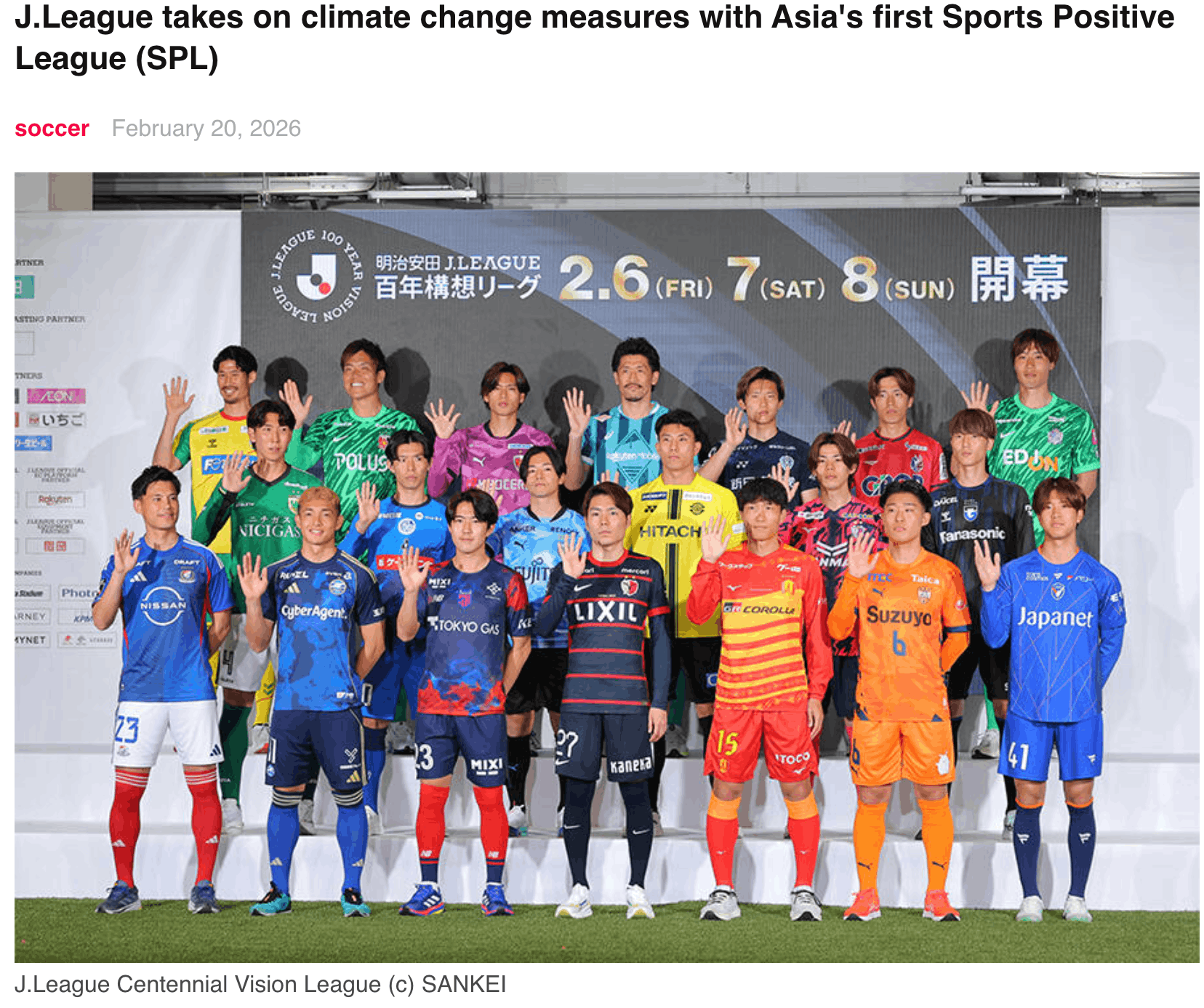
The new J.League season kicked off on the weekend of February 6th-8th with a special tournament before the start of the new season, the Meiji Yasuda Life Centennial Vision League, but new initiatives have also begun off the pitch this year.
The J.League has launched the Sports Positive League (SPL), a part of its climate change countermeasures. What are the off-the-pitch initiatives that will improve the environment, the first of their kind in Asia?
In recent years, the impact of rapid climate change has led to a steady stream of games being canceled due to heavy rain and typhoons. This trend has become particularly pronounced since 2018, with an average of 9.5 games canceled due to typhoons and linear rain bands since then, a dramatic increase from the average of about 2 games canceled in 2017.
The same goes for winter, with three matches being cancelled due to heavy snowfall on the opening day of the season on February 8th. The impact is not limited to matches, but has also been reported to have had an impact on club school activities, with JEF Chiba cancelling 65 class activities between June and August of last year.
The J.League, concerned about this situation, has introduced SPL, a system that quantifies J.League clubs’ climate change countermeasures and makes it easy to understand their progress and direction. The J.League officially joined the SPL in January of this year with the cooperation of the Nippon Foundation.
Some clubs have been taking individual steps to improve the environment, but with the introduction of SPL, this has now become a league-wide initiative.
J-League clubs are awarded points based on their level of achievement in 12 key areas of activity, such as renewable energy, energy efficiency, environmentally friendly transportation, waste reduction and management, and education, and the results of their efforts are displayed in a “leadership table” in the SPL, just like in matches.
This year, data will be collected on activities from January to June, then reviewed over the next two months, with the results scheduled to be announced in late November, with the top 20 clubs being selected for publication.
The aim is to share information on effective methods and to increase motivation in each club’s efforts, but the allocation of grants will also be determined based on the ranking.
The system has already been introduced in England’s Premier League and Championship, Germany’s Bundesliga, and France’s Ligue 1, and its effectiveness has been confirmed, but this will be the first time it is introduced in Asia by the J.League.
The role of the J.League and cooperation
To coincide with the full launch, the “Sustainability Conference 2026” was held in Tokyo on January 28th, with approximately 200 people in attendance, including representatives of J.League clubs, sponsoring companies, and other sports organizations.
SPL founder Claire Poole and Peter Smith, head of sustainability at Bristol City FC, gave lectures, and opinions were exchanged in a workshop.
Smith also cited the failure of Bristol City, where each department worked in isolation, and pointed out that “communication and collaboration are essential” to achieve results.
After the meeting, J.League Director Takayuki Tsujii, who is in charge of sustainability and has been promoting the introduction of SPL, seemed to have gained some satisfaction, saying, “We gained new members and it was a time when we really felt the expansion.” He added, “The role of the league is to be a platform provider. We would like to work together with the clubs to create examples that will lead to cost reductions and increased profits.”
Many of the participating J-League clubs expressed concerns about the costs involved in the activities, but Tsujii expressed his intention to respond flexibly to each case through his interactions with each club.
One idea suggested was for the league to act as a bridge between clubs and provide information on success stories, or for the league to purchase all necessary materials in bulk and sell them to clubs, following the example of the Premier League and Liverpool.
Involving fans
The J.League has set a goal of reducing league-wide CO2 emissions by 50% by 2030, and by displaying each club’s activities in the familiar “standings table,” the SPL hopes to encourage understanding among fans and supporters and get more people involved in the initiative.
“Many of the SPL measures relate to fan behaviour, such as travelling to the stadium and eating and drinking at the venue, so even if you don’t own the stadium you can still influence change,” Poole said.
“It’s like performance on the pitch; you can do well one year and then stop the next and it’s all back to square one. There is no championship or relegation in the SPL, but with the right mindset we can move this project forward and have a better impact on the environment,” he said.
Poole revealed that in the UK, where the Premier League and Europa League have joined in the five years since its founding in 2018, improvements have been made to the point that the league tables that were initially introduced are no longer necessary, and said, “I hope that with the J.League’s leadership, a common understanding will become so widespread that the SPL will no longer be necessary in five years.”
Smith also said, “This meeting is a new step in our efforts, but I’m sure we’ll look back on it in a few years and think it was a good thing. I’m sure that in the future we will be the ones learning from Japanese clubs and incorporating what we learn in England,” expressing his hope that activities in Japan will take hold and progress.
Tsujii says:
“When society changes, it’s very important that many people say, ‘That’s a good idea,’ and it becomes mainstream. One of Japan’s strengths is that it’s good at working together collectively. When everyone decides to do something together, everyone moves together. I want to make use of that strength and move forward.”
Despite bad weather including heavy snowfall during the three days of the opening round of this season’s special tournament, the Centennial League, the J.League recorded its highest attendance ever, with an average of 24,550 fans attending each match, breaking the previous record of 22,788 fans set in 2025.
Will they be able to shift their interest beyond just on-field performance to each club’s climate change initiatives, encouraging them to understand and participate? We’ll be keeping an eye on the new initiatives undertaken by the J.League and each club.
Interview and text: Kubo Kinohara
Read the original article here (JPN).
