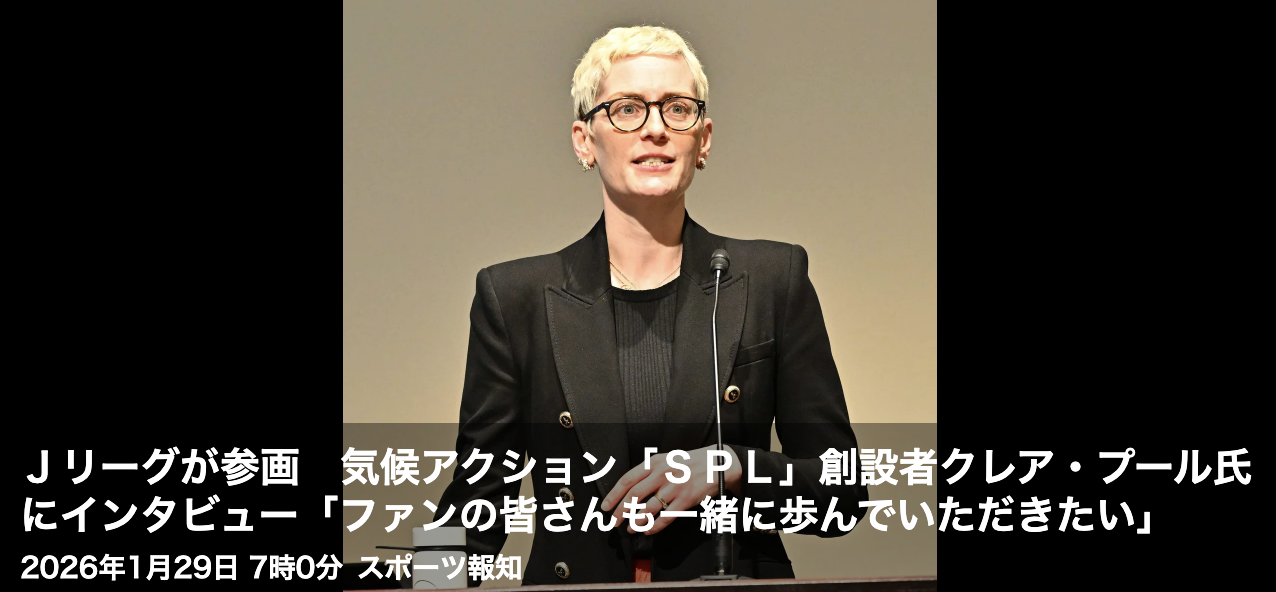
Sports Hochi: J.League joins climate action group “SPL” founder Claire Poole talks about joining the movement
The J.League’s Sustainability Conference 2026 was held in Tokyo on the 28th. Claire Poole, founder and CEO of Sport Positive, gave a keynote speech on the theme of “What is the Sport Positive League?” From January 2026, the J.League will become the first Asian league to participate in the Sport Positive League (SPL), a system that quantifies environmental sustainability efforts through sports as an action to solve the problem of climate change, and makes it easy to understand progress and the direction the league should aim for. Claire Poole gave an exclusive interview to Sports Hochi. (Iwahara Masayuki)
* * *
The J.League will join the SPL.
”I’m very impressed with the efforts that have been made so far. Everyone at the club is really acting with a positive attitude. As we discussed today, there are many good examples.”
The questions from the participants were very specific.
”It was really wonderful and insightful. I think it shows that everyone at the club is taking this seriously. It was clear that they were using this as an opportunity to share more information.”
The UK’s climate action efforts have been successful. What challenges have you faced?
”I think as a club matures, it becomes more difficult to make big changes. In the beginning, some of the actions may not have been easy, but some may have been easy. As you take small, easy actions, you then have to take on bigger, more difficult challenges. That’s a positive evolution, but it also means something big is happening. It also means there are bigger, more difficult challenges ahead.”
What is the biggest reason for the success of the initiative in the UK?
”I think it’s thanks to the football team, because they’re taking responsibility for the SPL.”
What are your expectations from Japanese clubs and their fans and supporters?
”I would like to place my hopes on the fans as an important point. Everyone is having a difficult time in their daily lives, so please be careful. I don’t want to tell supporters that this is their responsibility. I think it’s up to the clubs to take the lead and get the fans involved. And then we have a dialogue. I think we have a responsibility to explain the challenges and what the role of football is. And how we will get involved, and the local community as well.”
Is it important to reach out to children?
”It’s true that young people in Europe are more aware of environmental issues and take them very personally. They also pass on what they learn at school to their parents, which helps them understand the issues. A good example is the Mito Hollyhock team. It’s a wonderful story that began with an email sent by a fifth-grade boy, which led to the sale of soy burgers.*”
In your lecture, you emphasized that “awareness” is important.
”I think the challenges are money, human resources, expertise and priorities. For example, if there is leadership and that mindset, if we can find the money, hire more staff, build more expertise and clearly identify priorities, I think change will come swiftly. It all depends on how you think about it. SPL is still in its early stages, and I hope that it will continue to progress. I hope that Japanese fans will accept it and move forward with us. Perhaps in five years’ time, we will see a future where initiatives will be carried out in a more natural way, even without SPL (system).”
[Note] In November 2021, an email from a fifth-grader in Ibaraki Prefecture sparked the launch of the soy meat burger. The email was sent to all 58 J.League clubs, detailing the efforts the league is making to address environmental issues. Soybeans were then planted at Grassroots Farm, which led to the sale of the product. Mito supports projects started by children and is working to address global environmental issues.
About the Sports Positive League: A system that quantifies clubs’ climate actions, allowing them to grasp progress and the direction they should aim for at a glance. Regarding the status of 12 key climate change initiatives, data is collected on the environmental performance specific to the sports world, (for example) the energy efficiency of match venues and facilities, the use of renewable energy, recycling and waste reduction efforts, the management of carbon dioxide emissions associated with the travel of fans and players, collaboration with hometowns, and the promotion of environmental education for players. A unique scoring system quantitatively analyzes the effects, calculating an overall score for each category, such as energy, waste, and transportation. By visualizing environmental initiatives and publishing scores, the system promotes the sharing of best practices and motivates clubs to pursue higher goals.
Read the original article here (JPN).
