Mito Hollyhock’s Solar-Sharing Initiative: How a Football Club In Japan Is Growing Clean Energy and Crops
Mito Hollyhock’s Solar-Sharing Initiative: How a Football Club In Japan Is Growing Clean Energy and Crops
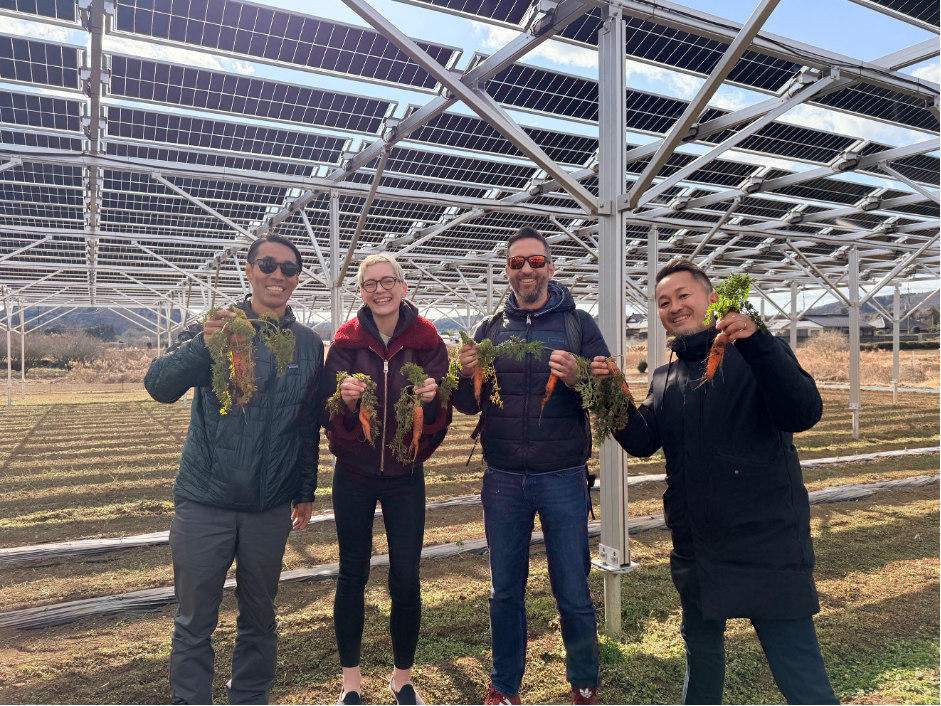
Image: L-R, Takayuki Tsujii, J.League; Claire Poole, Sport Positive; Peter Smith, Bristol City FC; Gengo Seta, Mito Hollyhock, at Mito Hollyhock’s solar sharing project. Photo credit: Sport Positive
By Claire Poole
In June 2025, Japanese football team, Mito Hollyhock, launched an innovative solar-sharing project in Shirosato-cho, Ibaraki Prefecture, combining renewable energy generation with sustainable agriculture.
This community-focused climate action initiative marked a milestone not only for the club, now competing at the top-level of football in Japan as a J1 team, but for Japan’s growing movement toward regenerative land use and local energy self-sufficiency.
The project recently won Japan’s Minister of the Environment Award for decarbonisation, and I was lucky enough to visit the project in Mito, during the launch of Sport Positive Leagues by the J.League in January 2025.
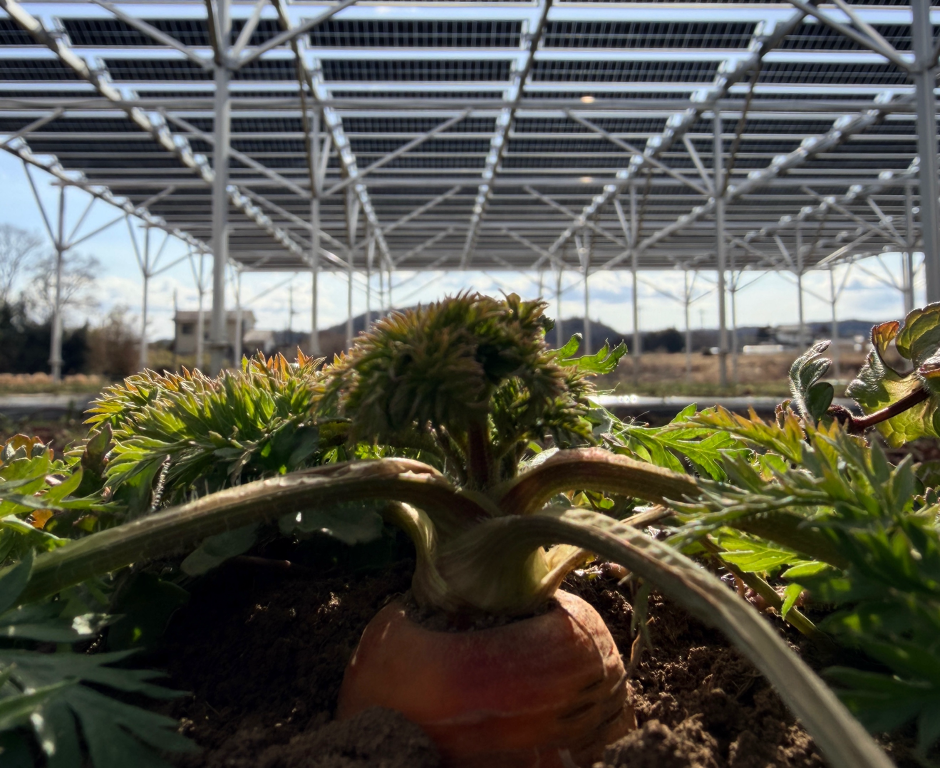
Image: Carrots growing under shade of solar panels at Mito Hollyhock’s solar sharing project. Photo credit: Sport Positive
What is Solar Sharing?
Solar sharing, or agrivoltaics, refers to a method of installing elevated solar panels over farmland in a way that still allows crops to be cultivated below.
The solar panels are not the large ones you see on the roofs of homes or commercial buildings. Rather they are long thin panels, that ensure plants receive enough sunlight while the panels generate electricity, effectively sharing the land between energy and agriculture.
This model is intended to maximize land productivity, diversify farmer income sources, and contribute to local energy solutions. The global market for agrivoltaics is expected to reach over US$8 billion by 2032.
The Mito Hollyhock Project
The Mito Hollyhock project transformed about 2,000 square meters of farmland into the “GRASS ROOTS FARM Solar Power Plant,” where both photovoltaic generation and agricultural activity co-exist.
The farmland is about 15 kilometres from Mito Hollyhock’s stadium, so electricity generated here has been supplied to nearby a community facility, Roadside Station Katsura, helping offset their energy needs and anchoring the local energy ecosystem.
A critical element of solar sharing in Japan is land use approval from agricultural committees, as changing farmland use historically requires permission. By securing this approval and developing the project over about three years from concept to launch, Mito Hollyhock and partners established a working model that satisfies regulatory conditions while maintaining the land’s agricultural character.
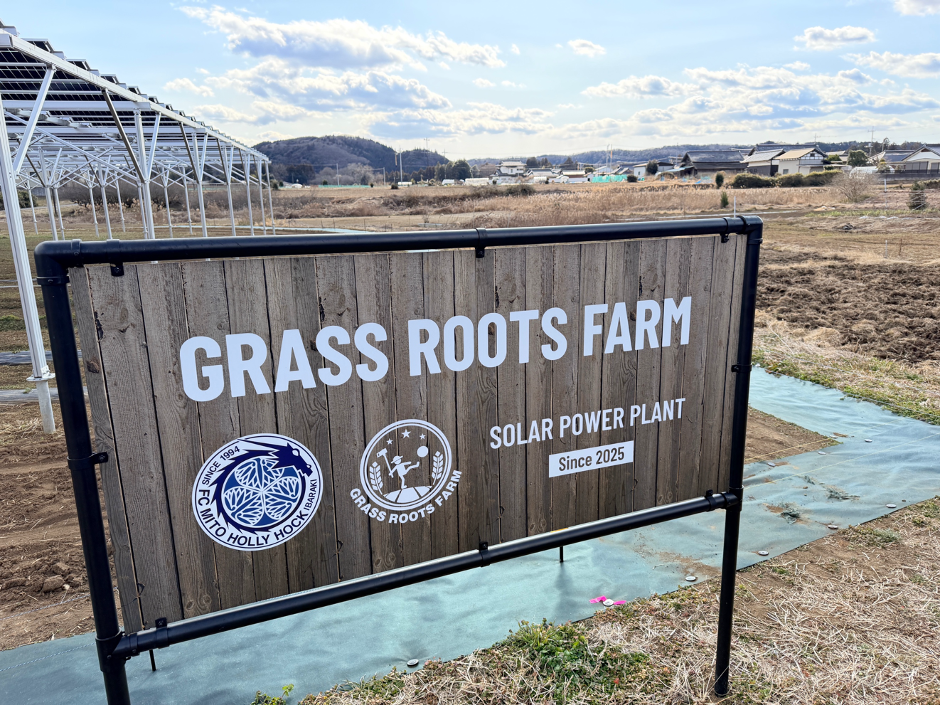
Image: Grass Roots Farm, Mito Hollyhock’s solar sharing project. Photo credit: Sport Positive
While national guidelines require periodic checks (typically every 3–5 years) to ensure that farmland remains productive, the dual-purpose system is designed to keep crops growing beneath the solar array.
Resourcing the farming component itself can be challenging for a football club, whose expertise lie elsewhere. To address this, the project collaborates with JA Group Ibaraki, which provides agricultural expertise, soil management advice and technical support to ensure the land stays fertile and productive. Discussions are under way about involving community members and volunteers in the future to further strengthen the social impact of the initiative.
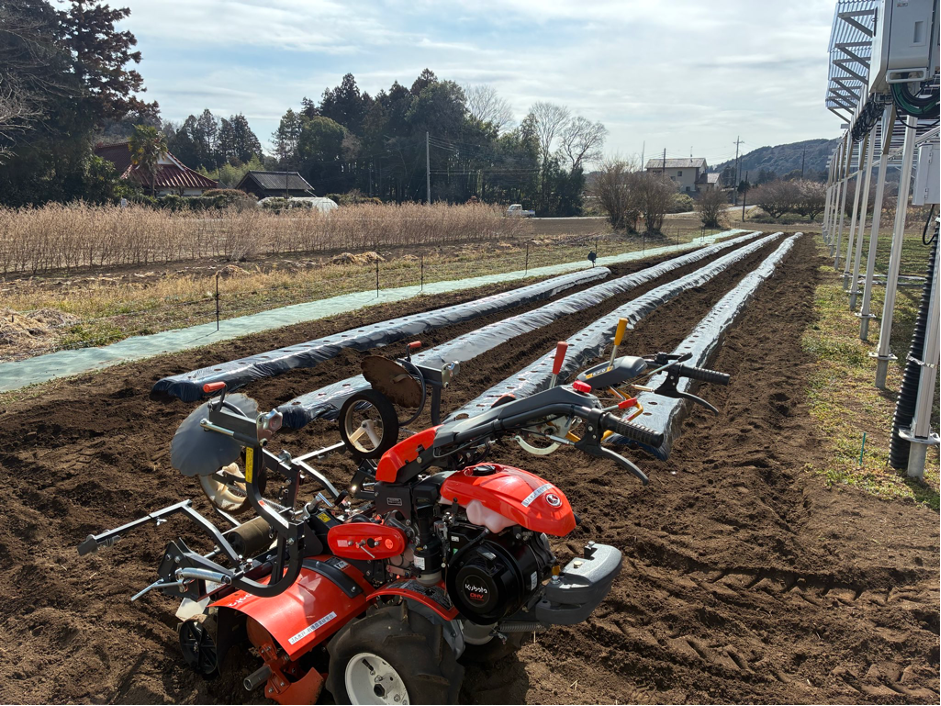
Image: Grass Roots Farm preparations to plant potatoes,, February 2026.Photo Credit: Seta Gengo/Mito Hollyhock FC
Benefits of Solar Sharing
Solar sharing means that crops get direct sunlight, but also shade throughout the day, depending on where the sun is in the sky. In the summer this can prevent crops getting “sun-scalded”, a risk from excessive sunlight, high temperatures and low humidity.
This approach also strengthens local resilience. As the solar panels are spaced apart, the system is less vulnerable to high winds and typhoons, an important factor in a region where these weather events are expected annually.
Farmers can also benefit in multiple ways. By leasing their land, they could receive a small income and retain agricultural tax advantages, however Mr Gengo Seta, Executive Officer at FC Mito Hollyhock told me they have found that “the more meaningful benefit is that the landowner is freed from the continuous burden of managing and maintaining the farmland.” This is especially beneficial for aging farmers, who can no longer work the land themselves and perhaps don’t have children who wish to continue farming. Mito Hollyhock have made a 20-year lease agreement with the landowner.
The generation of clean energy benefits the community it is supplied into. In the case of Mito Hollyhock, at the moment the generated electricity supplies around 30% of the roadside community service area’s energy needs.
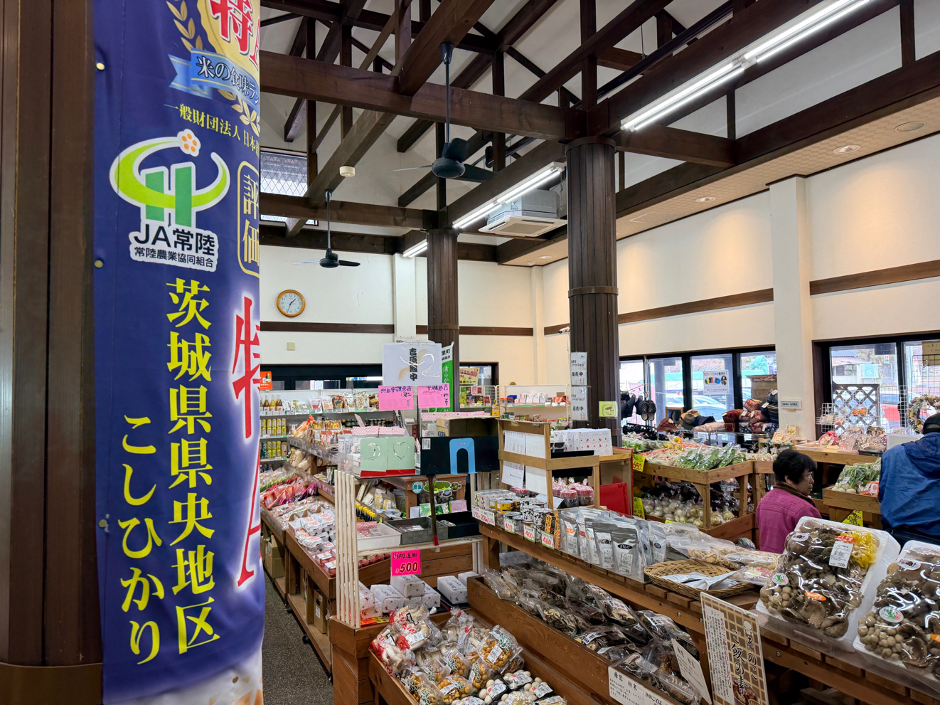
Image: Inside Roadside Station Katsura, a local community hub. Credit: Sport Positive
Growth of Solar Sharing In Japan
This initiative reflects a growing interest in organic and regenerative agriculture in Japan. National organic farmland remains a small fraction of total agricultural land, and in 2023 only 1.5% of the population said that they have purchased organic food.
The Japanese government has set ambitious goals to significantly increase this, aiming for 25% or one million hectares of farmland to be organic by 2050 under the “MIDORI Strategy”.
A football club, or sports more broadly, serving as a case study of this activity, offers a unique way to raise awareness and engagement among residents or fans who might not otherwise be involved in organic agriculture or renewable energy discussions.
By harnessing the power of the sun to produce both clean electricity and food, the Mito Hollyhock solar-sharing project represents a compelling example of a sports club acting as a catalyst for environmental action, rural support, and community cohesion. As it matures, it offers a blueprint for similar projects across Japan and the world, and highlights how sport can play a role in enabling energy production, agriculture and sustainability to thrive together.
