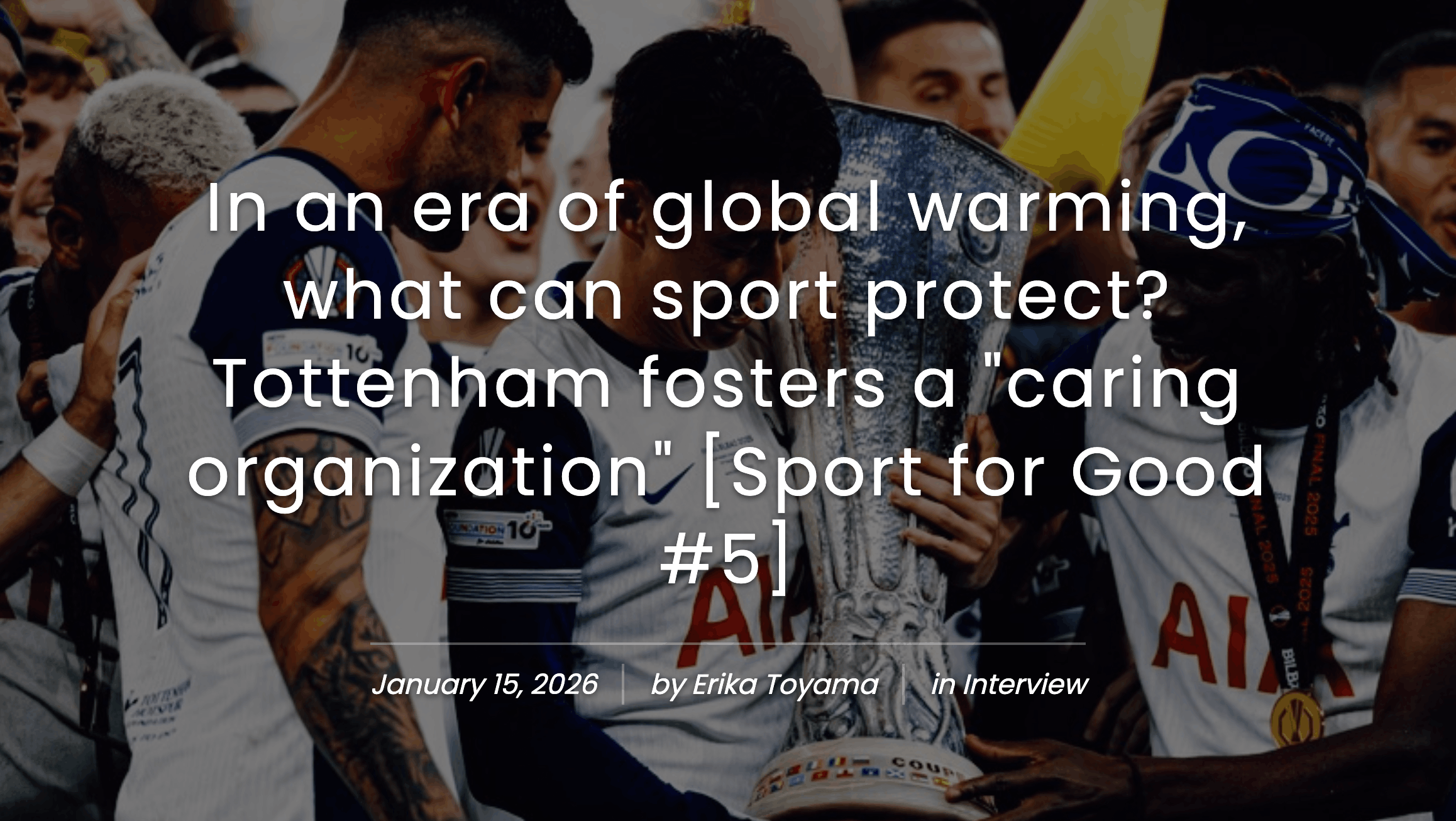
Ideas For Good: In an era of global warming, what can sport protect? Tottenham fosters a “caring organization” [Sport for Good #5]
With rising temperatures becoming a well-known fact and the world now being called the “age of the boiling earth,” there is no industry that is immune to the effects of climate change.
One industry feeling a sense of crisis about the current situation is the sports world. Athletes, who try to maximize their performance by adapting their bodies to the environment around them, are said to be acutely aware of changes such as rising temperatures.
The sports world is already making strong efforts to combat climate change around the world. IDEAS FOR GOOD has teamed up with the Sport For Smile Planet League, which has been promoting climate change responses in the sports world in Japan, to bring you a special feature titled ” Sport for Good ” that explores efforts to promote sustainability in the sports world around the world.
This time, we will be introducing Tottenham Hotspur FC (hereafter referred to as Tottenham), a club in the English Premier League. The Premier League is known as the world’s most commercially successful football league, where winning and profits, including from the broadcasting rights business, are highly valued. At the heart of this league, Tottenham has distinguished itself as “the club with the most environmentally friendly approach.”
The club has signed the UN and IOC-led Sport Climate Action Framework, aiming to halve its CO2 emissions by 2030 and achieve net zero by 2040 – 10 years ahead of the UK government’s target. It has also been ranked first for five consecutive years in the Sport Positive League, which measures the sustainability progress of professional sports leagues, and has promoted the use of 100% renewable electricity for its stadiums and training facilities, as well as behavioral change involving players and fans. Furthermore, the club has signed the UN biodiversity framework, Sports for Nature, making it one of the few well-known clubs to make clear commitments on both the climate and nature fronts.
“Sustainability is not CSR or added value. It is the very essence of an organization.”
So says Ryan Norris, Tottenham’s Chief Revenue Officer. In this article, we interview Norris, who is responsible for the club’s revenue, and Marcus Parry, the sustainability manager who oversees environmental measures on site, to understand why sustainability can be at the core of a business strategy in the world of professional sports, where winning is paramount.
Be a “careful club.” A guideline for coexistence with victory
“Sustainability is not just part of our business strategy; it’s in our DNA.”
Ryan Norris states this clearly. Tottenham has had the motto “To Dare Is To Do” since the club was founded. This spirit of fearlessly moving forward even in difficult situations is also demonstrated in the face of the biggest challenge of our time: environmental issues.
However, it is not just “challenge” that they value. Although they are an organization that aims to win, they also have some principles that they hold dear.
“We have a guiding principle that we are a ‘club that cares’. Of course, the primary reason we are here is to win games, but we understand we are more than just a football team,” Norris said .
This spirit of care is deeply connected to the environment in which the club operates.
“We are based in one of the most deprived areas of London, so we have a huge responsibility – to make our fans proud in every way, to bring prosperity to our neighbourhood and to drive positive change,” Norris said .
Tottenham has set a “net zero” target of achieving net-zero greenhouse gas emissions by 2040, a more ambitious target that is 10 years ahead of the UK government’s target.
“We pride ourselves on being a club that, first and foremost, does the right thing for people, the planet and our communities,” said Norris . “Optimising our energy use and using materials that reduce carbon emissions are the result of conscious decisions.”
True to Ryan’s words, the club is taking thorough measures. All facilities, including the stadium and training centre, run on 100% renewable electricity and have achieved zero greenhouse gas emissions (Scope 2) associated with electricity use. Furthermore, the club is the first UK stadium to become completely cashless and has also pledged to reduce the use of single-use plastics.
But one question arises: in the world of professional sports, where winning is essential, are environmental considerations a hindrance? Ryan immediately denies this.
“Demonstrating environmental leadership is good for our business,” Norris said . “Our partners, like Nike, Schneider Electric and HPE, want to share the same values as us, and climate change is deeply integrated into their sponsorship strategies.”
Being environmentally conscious is no longer a cost, but a powerful business asset. Tottenham’s example proves that economic rationality and social justice can go hand in hand.
Stadiums transform from “lumps of concrete” to “ecosystems”
As a top priority in combating climate change, it is essential to pursue “numbers” such as reducing CO2 emissions. However, Tottenham’s focus is not limited to that, but is also directed more broadly at the “nature” under their feet. Tottenham was also the first Premier League club to sign the United Nations biodiversity framework, “Sports for Nature.”
“Climate change and biodiversity are inextricably linked,” says Sustainability Manager Marcus.
Marcus: “No matter how much we reduce carbon dioxide emissions, if we don’t protect the natural environment itself, it won’t be a solution in the long run.”
Located in a greenbelt area on the outskirts of London, the training center prioritized the restoration and preservation of the natural environment during its development. The center not only maintains the lawn, but also has a system in place to monitor bird and bee activity.
Marcus: “We understand that biodiversity is essential for human survival. It is our responsibility to leave nature in a better state for future generations than when we arrived.”
Stadiums and facilities, which are often thought of as inorganic concrete structures, are reconsidered as “part of the ecosystem” that coexists with the surrounding nature. This holistic approach is Tottenham’s strength. Waste generated from the stadium is processed through an advanced management system, and zero waste is sent to landfills. Resources continue to circulate within the living organism that is the stadium.
Players and fans alike: “Green Passing” spreads beyond the pitch
The most unique aspect of Tottenham’s approach is that it doesn’t just limit its influence to themselves: they’re trying to create a massive movement that involves around 800 staff members, millions of fans around the world, and even the star players on the pitch.
“Football clubs have a huge influence,” Marcus said.
“When we speak out about social issues, people take notice and it motivates them to change their behavior,” Marcus said .
A prime example of this is the sustainability education provided to players: Tottenham was one of the first clubs to provide sustainability training to first-team players, and is now also providing this to its academy players.
Marcus: “Players can be powerful ambassadors for our efforts. If players understand and communicate, they can encourage behavioral change among fans.”
They are also encouraging fans to switch to more environmentally friendly means of transportation when attending games, and are increasing the number of plant-based food options available at stadiums, among other natural and sustainable choices. Even small actions like properly disposing of waste in recycling bins can have a big impact when tens of thousands of people join together.
Moreover, its influence transcends national borders: during a pre-season tour of Tokyo in the summer of 2024, Tottenham teamed up with the Nippon Foundation to host a sustainability conference, inviting representatives from J.League clubs.
“When you talk to partners anywhere in the world, there’s a willingness to learn and share ideas,” Norris recalls.
“We all live on the same planet,” Norris said . “Even if we’re competitors, we all share a common responsibility to protect it.”
The next focus is the supply chain
While Tottenham’s challenge seems to be going smoothly, the goal is still far away. The biggest challenge they currently face is reducing emissions from their entire supply chain (Scope 3).
“Approximately 67% of our carbon emissions are related to procurement,” Marcus explains. It is not easy to accurately identify and reduce emissions generated outside of our own activities, such as merchandise, food, and construction materials sold at stadiums.
Marcus: “We need to work collaboratively with our suppliers and partners. We’re getting them to implement the same processes as us, so we can get more reliable data and understand the full carbon picture inherent in our supply chain.”
This is not a problem that Tottenham can solve alone, which is why they continue to demonstrate leadership.
“By leading the way, others will follow suit, and we can move this issue forward across the sporting community and society as a whole,” Norris said .
Marcus emphasized:
Marcus: “Without top-down leadership, you can’t embed sustainability within an organization. The most important thing is to believe in what you’re doing and take responsibility for it.”
Their goal is not just to reach the top of the league table. They also care about the local community, the natural environment, and the next generation of fans. Their approach to striving for strength while “caring” for all stakeholders could be said to be redefining the very nature of professional sports clubs in the 21st century.
Read the original article here.
